In late October a Japanese investment group called Nexroc, together with a company called SVCV, announced that it wanted to buy 25 to 50 percent of JYP Entertainment through a tender offer. JYP's share price jumped, fans worried, and Korean regulators started watching. This is where things stand on 17 November 2026.
The short answer: no, not right now
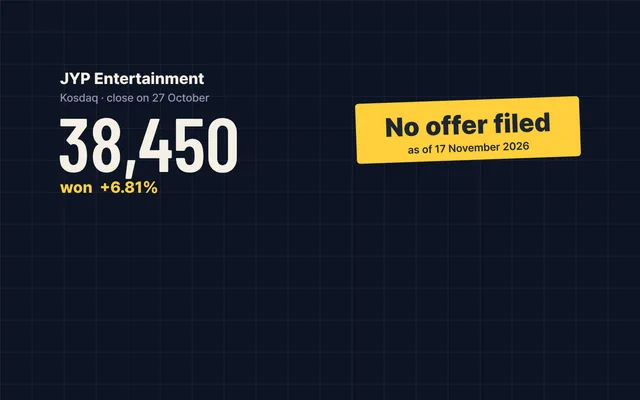
No formal tender offer has been filed. Korean media have found no registration with the regulator, no fixed price and no offer period. The start date of 20 November that Nexroc first named is off the table: in a letter to its own investors, Nexroc now gives January 2027 as a provisional moment for a tender offer, after it sends proposals to 14 companies and negotiates with them for 60 days, The Korea Herald reported. In a later letter Nexroc said it now wants 25 percent, not up to half. Price and timing have not been set.
Who are Nexroc and SVCV?
By its own description, The NEXROC Group is a Japanese investment and holding company founded in February 2026, and SVCV invests in fashion, media and entertainment. Nexroc says it has a takeover programme of 2 billion dollars over 32 months, with targets in entertainment, finance, insurance and fashion, JYP and the Japanese company Avex among them. In the three weeks before the JYP announcement it announced plans for at least five other companies in Korea, the US, Japan and Australia.
Independent information is thinner. Reuters called the firms "little-known". Filings with the US Securities and Exchange Commission show a company named Nexroc SVCV Inc., formerly SVCV Group Inc., with stated yearly revenue of 1 to 5 million dollars. A filing from 2 November for a private placement of 300 million dollars showed nothing sold and no investors. Nexroc says it has a balance sheet of about 100 million dollars but has named no committed financing and no lenders. The funding plan on its website is labelled as an example, not as secured money. No source we found mentions a completed takeover by either firm.
One more detail comes from Nexroc itself. In a letter to investors dated 5 November, reported by Sports Khan, the company wrote that it had "suspended operations in January of this year due to internal restructuring".
How the "takeover" was announced, and why regulators called it unusual
Normally a buyer first files a tender offer registration statement with proof that it can pay, and only then makes the offer public. Nexroc did it the other way round. The Financial Supervisory Service (FSS), Korea's financial watchdog, called a public announcement before any registration "very unusual". It said this makes it hard to check who the bidders are and how they are funded, that the deal may never happen, and that it would look into any signs of unfair trading. It also warned investors that they could lose money when a share price swings like this. Nexroc said it had been in contact with the FSS. The FSS said there was no contact.
Analysts were sceptical too. Douglas Kim of Smartkarma told Reuters that a company should only make an offer once its financing is in place, and that announcing one in advance "could set a bad precedent in the Korean equity markets". Lee Nara of Sangsangin Securities said: "There are many doubts about what the company is."
JYP's response: no proposal, and an email caught by the spam filter
JYP answered the same day. "We have not received any proposal regarding the acquisition of shares in our company," the agency said, and on 27 October it repeated this in an official notice to the Korea Exchange. Nexroc then said it had emailed JYP on 21 October. JYP checked with its email provider and said the message had been stopped by its security system as spam, adding that it had "not received or reviewed any officially valid proposal". Founder Park Jin-young has not commented himself in any source we found. We have covered the back-and-forth in our headlines: the first claim and the spam email.
Who actually owns JYP?
JYP is listed on the Kosdaq, so anyone can buy its shares. The largest shareholder is Park Jin-young, who together with related parties holds about 15 to 16 percent, according to The Korea Herald, Korea Economic TV and Reuters. That is a smaller stake than at the other big agencies: Korean media put the largest shareholder and related parties at 22 percent of YG, 32 percent of HYBE and 41 percent of SM. With 25 percent, Nexroc could in theory become the largest shareholder, but that would not guarantee control, The Korea Herald noted.
What happened to JYP's share price
The news came out in the evening of 26 October. In after-hours trading on Nextrade, JYP's shares rose 14.38 percent to 42,150 won. On 27 October the stock climbed as much as 11.53 percent on the Kosdaq and closed at 38,450 won, up 6.81 percent. The next day it swung by more than 4 percent within a single session. At the close on 2 November JYP was worth about 1.35 trillion won, roughly 1 billion dollars. Before all this, the share price had been in a dip since July, after weak second-quarter results.
What is a tender offer, and how does it work in Korea?
A tender offer is a public offer to all shareholders to buy their shares at a fixed price. In South Korea it is required when someone, together with related parties, wants to buy 5 percent or more of a listed company outside the stock exchange from ten or more people within six months. The buyer must first file a registration statement that shows it can pay, for example with money in the bank. Anyone who holds 5 percent or more must report it within five working days, and after that every change of 1 percent or more.
That is why a tender offer cannot start without a filing that everyone can see. As long as there is none, there is no offer that shareholders can accept.
What it means for TWICE, Stray Kids and the rest of the JYP family
For now, nothing changes. There is no offer, so there is no new owner. None of the reports we found looks at what a takeover would mean for the agency's artists, who include TWICE, Stray Kids, ITZY, NMIXX, DAY6, NiziU and NEXZ, so we will not guess either. If Nexroc does file a tender offer, it will be public, and we will update this story and our headlines.